For years, Michael Stern—a name that literally means “star” in German—positioned himself as New York’s boldest developer: audacious supertall skyscrapers, record-shattering prices, glossy renders, and a carefully crafted aura of unstoppable success.
Today, his name still graces headlines.
But the man himself? He’s largely vanished from the scene.
The market keeps logging deals under the JDS logo, numbers that look impressive on paper, and press releases chug along on autopilot. Just last week, The Real Deal reported a $21.3 million closing for an apartment at 111 West 57th Street—one of the priciest on Billionaires’ Row.
Yet behind the polished facade, a different narrative is circulating among New York’s and Miami’s developers, brokers, and investors:
Michael Stern is no longer operating as a developer.
Deals Without a Company
Multiple market sources say Stern laid off his entire internal team about a month ago.
Not a restructure.
Not cost-cutting.
A complete operational shutdown.
No acquisitions team.
No pre-development pipeline.
No active slate of new projects.
What’s left are inertial closings—deals from projects launched years ago, now trickling to completion. Sales keep happening. But the engine that originated them has effectively stopped.
This isn’t a bankruptcy story. No indictments. No spectacular implosion. Just… absence.
From Developer to Phantom
In practice, JDS Development Group increasingly resembles less a development platform and more a shell, converting the lingering momentum of old projects into cash.
Partners finish buildings. Brokers move units. Lawyers handle exits.
The “developer” himself often exists only as a name attached to assets conceived long ago.
In industry circles, this limbo has earned an unofficial but spot-on label: the ghost developer.
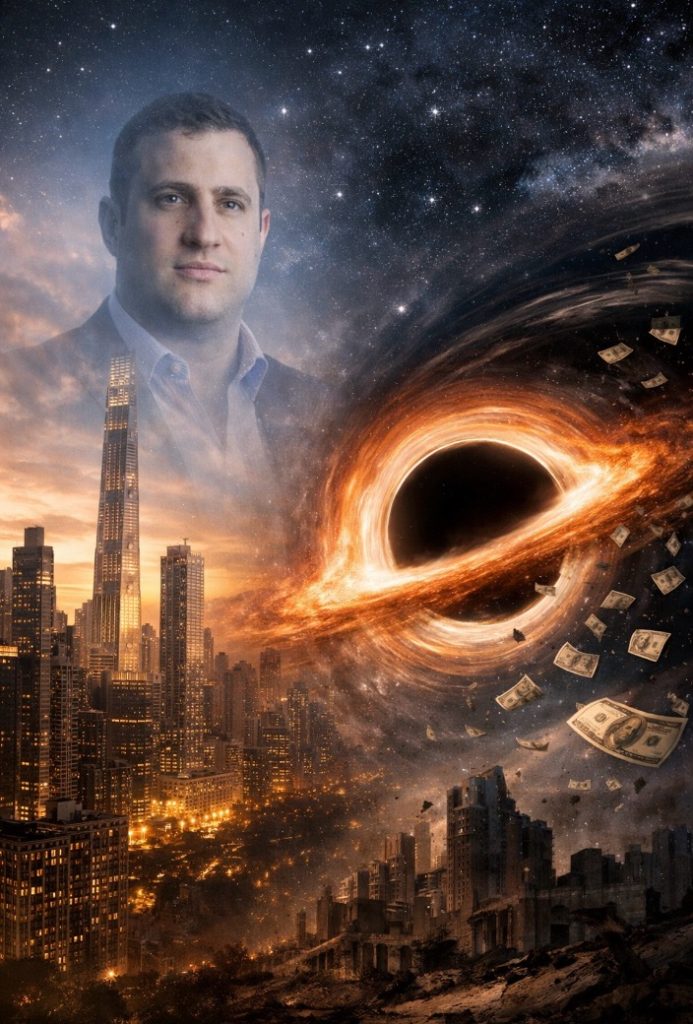
The Astrophysics of Vanishing Investor Money
In astronomy, when light disappears, it doesn’t always mean the object’s influence has.
In finance, even less so.
A massive star collapsing into a black hole stops emitting light, becoming invisible to direct observation. But its gravity remains immense. Space warps around it, matter vanishes, and its presence is inferred only from what’s missing nearby.
The parallel in real estate is hard to ignore.
Stern’s black hole absorbs investor capital—and leaves no visible developer behind.
No fresh concepts. No forward momentum.
Just the residual “gravity” of past projects.
A Star in Name Only
Stern means “star.”
But on today’s market, it’s more like a collapsed one.
The name still reflects in headlines.
Its pull lingers in legacy assets.
But the operational core—the developer himself—has faded away.
Like a true black hole, this phase is defined not by what’s seen, but by what’s no longer there.
In real estate, absence isn’t just a metaphor. It’s a warning signal.