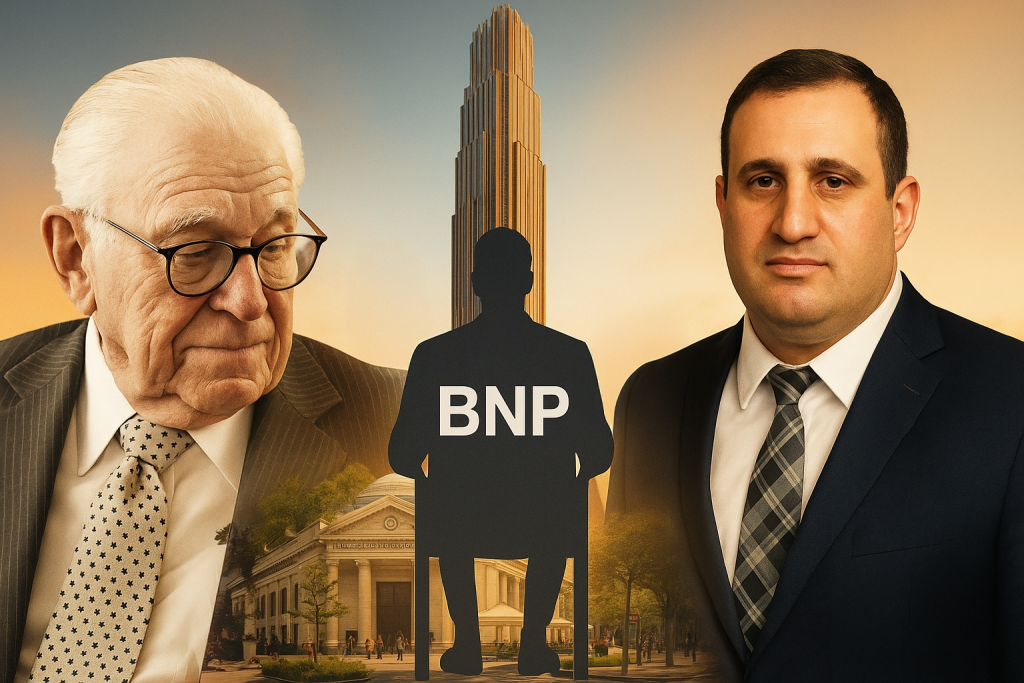
Once a marble temple of savings for ordinary Brooklynites, Dime Savings Bank now sits inside 9 DeKalb as a preserved monument — and a backdrop to how a modern “bank-safe” project erased an investor’s equity instead of protecting it.
JDS Development and the Hidden Mechanics of the Silverstein Deal
The tower meant to redefine Brooklyn’s skyline has become a cautionary tale of high-stakes real estate finance.
At 9 DeKalb Avenue stands the Brooklyn Tower—Brooklyn’s first supertall skyscraper, a 1,066-foot bronze-and-black monolith rising from the restored historic Dime Savings Bank. Promoted by JDS Development as a manifesto for the borough’s ascent, it promised 74 floors of luxury condominiums, rooftop pools, exclusive club levels, and a “new New York horizon.” Glossy renderings and bold marketing masked a far grittier reality: an investor whose stake, valued at more than $50 million, was effectively erased in a post-default transaction.
That investor, BNP Development, saw its equity wiped out as control shifted to entities affiliated with Silverstein Properties. Today, BNP is fighting in New York courts for one basic right—to inspect the documents explaining precisely how its ownership interest was reduced to zero.
How BNP Ended Up at the Bottom of the Capital Stack
On paper, the project followed the classic structure of a major real estate development:
- At the top: senior bank debt, the safest layer.
- Below it: mezzanine financing, secured by pledges of ownership interests in the project entity.
- At the very bottom: equity investors, who assume the greatest risk in exchange for the largest potential upside.
BNP entered 9 DeKalb as precisely such an equity partner. Court filings in New York Supreme Court value BNP’s now-nullified stake at over $50 million. Those funds were intended to service interest payments, pay contractors, fund construction and finishes, and bridge cash-flow gaps.
As long as condominium sales tracked projections and debt remained manageable, the setup appeared as standard high-risk, high-reward investing. The dynamics shifted dramatically when the debt layers began crushing the equity beneath them.
The Turning Point: Default and the Silverstein Transaction
By 2024, Michael Stern’s JDS could no longer sustain the narrative that the project was on track. Condo sales lagged, debt burdens—exacerbated by rising interest rates—grew heavier than marketing materials ever admitted, and mezzanine lenders moved from presentations to enforcement actions.
The Brooklyn Tower morphed from “icon of the new Brooklyn” into a distressed asset, where the central question was no longer penthouse views but who would exit with nothing in the equity column.
Enter Silverstein Properties—not as a buyer of luxury units, but as the player positioned to seize control when the original developer lost its footing.
The project had accumulated substantial mezzanine debt, while sales and occupancy fell short of ambitious forecasts and repayment schedules. The asset’s value and cash flow could no longer comfortably support the full debt stack.
In such scenarios, the fork in the road is familiar: either the developer negotiates a restructuring with lenders and investors, or lenders initiate foreclosure (typically a UCC auction), with equity first in line for wipeout.
Court records in the BNP vs. JDS matter contain a damning admission JDS cannot retract: In June 2024, JDS-affiliated entities closed a transaction with Silverstein after which all project equity—including BNP’s share—was “wiped out.”
In financial terms, this meant:
- Control of the tower transferred to the new player.
- The debt stack was restructured to favor lenders and the incoming owner.
- Prior equity holders, including BNP, were left “out of the money”—their interests worthless and stripped of any claim to future profits.
The physical tower remained intact. What vanished was the economic value of one investor’s commitment.
What BNP Wants Now: Not Just Recovery, But Transparency
Post-transaction, BNP was left without ownership but with plenty of unanswered questions.
The firm turned to arbitration under the American Arbitration Association. The arbitrator issued partial and final awards granting BNP access to the project entity’s books and records, and compelling JDS to produce documents tied to finances and the equity-erasing deal.
Undeterred by verbal assurances, BNP escalated to New York Supreme Court, filing a special proceeding under Article 75 of the CPLR to confirm the awards and enforce disclosure. The petition is blunt: BNP seeks judicial confirmation of its right to financial and corporate records, explicitly noting the disputed interest exceeds $50 million.
In plain terms, BNP is telling the court: “Our multimillion-dollar stake was erased in a single transaction—now we demand to see exactly how it happened.”
JDS’s Defense: Acknowledge the Wipeout, But Block the Paper Trail
JDS’s response in the special proceeding deploys a familiar playbook for resisting scrutiny.
On one hand:
- It hails the project as one of New York’s “most recognizable supertall buildings.”
- It concedes BNP was an investor.
- It admits the transaction nullified all equity.
On the other:
- It argues the arbitrator exceeded his authority.
- It calls the arbitrator’s contract interpretation “irrational” and contrary to Delaware law.
- It claims thousands of pages have already been produced and no further disclosure is required.
- It portrays BNP as a “serial litigant” filing “oppressive” claims for “improper motives.”
Yet these objections sidestep the core issue: If the wipeout was fair and inevitable, why the relentless opposition to letting the investor simply review the records?
The obvious inference—one already fueling other litigation against JDS entities—is that full disclosure might reveal discrepancies between how funds were used, how the deal was structured, and what partners and the market were led to believe.
This is the invisible portion of the Silverstein transaction JDS appears determined to keep out of public view.
The Court Battle Against Opacity
BNP’s fight for transparency extends beyond arbitration. In a parallel commercial action in New York against 9 DeKalb Fee Owner and related entities, defendants sought to seal nearly everything: the unredacted complaint, contract exhibits, legal memoranda.
The Commercial Division judge rejected blanket secrecy, reaffirming public access to court records as the default. Only genuinely confidential items—specific agreement terms, third-party trade secrets—may be redacted. Turning the entire case into a “black box” was denied.
Even with some redactions, the broader contours of the deal and the dispute will emerge—a complication for JDS.
The Tower as Symptom: 9 DeKalb in a Pattern of JDS Challenges
BNP’s saga is not isolated. In a separate Brooklyn lawsuit stemming from an on-site injury, courts have painted another unflattering portrait: a promotional tour of the active construction site for women interested in the trades, a fall on the 37th floor caused by protruding debris, and serious injuries. JDS entities attempted to shift blame to a nonprofit, but the court kept the developer central to the case.
Taken together, the picture is stark:
- At the pinnacle: an architectural symbol of “new Brooklyn” ambition.
- In the financial trenches: defaults, restructurings, and a zeroed-out investor.
- On the ground: safety disputes and litigation.
Conclusion: A Tower That Consumed Its Own Investor
No one alleges BNP’s capital was misappropriated into thin air. The money flowed where it typically does in troubled projects—into steel, glass, bank interest, and servicing a complex debt stack.
From BNP’s perspective, however, the outcome is unequivocal: a stake worth tens of millions vanished amid the tower’s default; control and future upside transferred to new owners; the investor was left only with questions—and fierce resistance when seeking answers.
For JDS, this represents a perilous front where brand image collides with mandatory judicial disclosure. For BNP and similarly situated investors, it tests whether New York courts will safeguard the fundamental right to understand how, in one opaque transaction, their equity was erased.
This publication will continue monitoring the case as a potential precedent for investor protections in complex development structures.