Update (April 2026):
Following the publication of The Real Deal article, JDSPulse’s position was partially reflected in the coverage. The outlet quoted JDSPulse describing itself as “an independent editorial platform that publishes materials based on documents, sources, and investigative analysis” and rejecting the characterization of its work as an “anonymous smear campaign.”
The Real Deal reported on April 21, 2026 that Michael Stern has petitioned the New York State Supreme Court to compel Meta, X, Google, Cloudflare, and Namecheap to disclose identifying information related to the JDSPulse website and associated social media accounts.
In that filing, JDSPulse is described as a “coordinated and sustained anonymous smear campaign.”
This characterization is both legally consequential and factually untested.
Notably, JDSPulse’s position was not reflected in the published coverage. At the time of the journalist’s outreach, less than a day remained before publication — a timeframe that did not allow for a meaningful or substantive response. The result is a one-sided narrative built primarily on the allegations of a litigant.
JDSPulse therefore considers it necessary to respond.
JDSPulse is not a single-author outlet, nor is it reducible to an “anonymous operator.” It is an independent editorial platform that publishes materials from multiple contributors, including documentary evidence, firsthand accounts, editorial analysis, and open letters from individuals with direct or indirect knowledge of projects, transactions, contractor relationships, financing arrangements, and investment activities associated with Michael Stern and JDS Development Group.
Its reporting addresses matters of clear public interest: the conduct of complex real estate projects, the allocation of risk, and the experiences of market participants.
The central issue, however, is not how JDSPulse is labeled, but what it has published.
To date, there has been no substantive, point-by-point rebuttal of the specific factual assertions contained in JDSPulse’s reporting. Instead, the chosen course of action has been to seek judicial mechanisms to identify those involved in producing or contributing to that reporting.
This distinction matters.
Legal efforts aimed at unmasking contributors do not, in themselves, establish falsity. They do not engage with the accuracy of the underlying materials. They do not answer the questions raised. Rather, they shift the terrain — from scrutiny of facts to scrutiny of identities.
Such a shift is not uncommon in disputes involving contested reporting, but it does not resolve the underlying issues.
It is also relevant that JDSPulse’s reporting has previously been referenced by industry media, including The Real Deal, as a source of information on certain projects. This underscores that the platform’s content has entered the broader informational ecosystem and has been treated, at least in part, as relevant to ongoing coverage.
Against that background, attempts to frame JDSPulse solely as a vehicle for anonymous disparagement are necessarily incomplete.
Requests for Identification
Following JDSPulse’s response to media inquiries, additional questions were raised regarding the identity of contributors, editorial structure, geographic location, and the origin of documents referenced in prior publications.
Such inquiries are standard in journalistic practice.
However, in the context of ongoing legal efforts aimed at identifying individuals associated with the platform, they also illustrate how the focus surrounding JDSPulse increasingly extends beyond the substance of published materials.
Rising Attention — and Access Attempts
At the same time, activity surrounding JDSPulse has not been limited to legal proceedings.
Since January 23, the platform has recorded 68,800 attempts to access administrative areas of the site, including repeated login attempts using standard credentials and non-existent accounts.
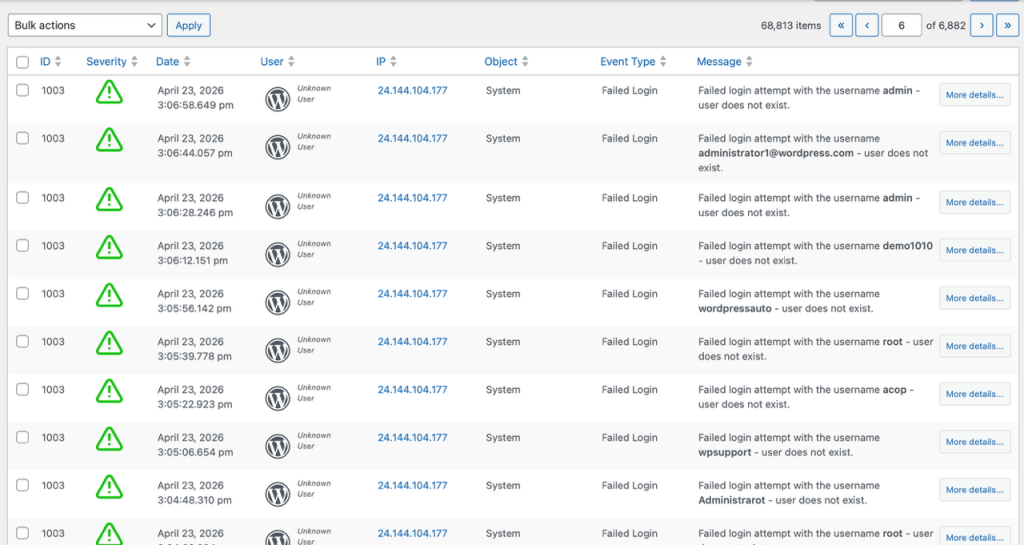
Such activity is consistent with automated scanning and credential probing commonly directed at publicly visible platforms. However, its scale and persistence point to sustained external interest.
Notably, spikes in this activity have coincided with periods of increased media attention referencing JDSPulse.
Facts or Identities
The convergence of legal action, public scrutiny, and increased technical probing points to a broader dynamic.
Yet the central question remains unchanged:
are the published materials accurate, and can they be refuted on their merits?
Efforts to identify contributors or access administrative systems do not, in themselves, answer that question. They do not constitute a rebuttal. They do not engage with the substance of the reporting.
They shift the focus.
Conclusion
The intersection of large-scale development, investor disputes, and public scrutiny is not unique.
But when legal pressure converges with attempts to identify contributors and increased technical interest in a platform, the distinction becomes critical:
between responding to facts —
and responding to those who bring them forward.
In such conditions, the boundary between legitimate inquiry and pressure to disclose sources becomes increasingly difficult to distinguish.
For observers, the distinction is clear. For the public, it is consequential.