Follow-Up to “From Article to Lawsuit: How the JDS Pulse Publication Pushed Michael Stern into Court”
Sources and Methodology:
This report is based on court document Exhibit K (NYSCEF Doc. No. 22), filed in case Index No. 659132/2025 in the New York State Supreme Court, as well as prior reporting from JDS Pulse and specialized business media outlets. All analytical conclusions draw directly from documented records and publicly verifiable sources.
Primary Court Source:
New York State Courts Electronic Filing (NYSCEF) system
Search Index No. 659132/2025, New York County.
On December 8, 2025, a chain of emails between Michael Stern of JDS Development Group and attorneys at Kasowitz LLP was filed as Exhibit K (NYSCEF Doc. No. 22) in the ongoing New York County Supreme Court case Index No. 659132/2025.
What appears at first glance as routine correspondence about “checks” in fact distills a recurring pattern previously highlighted in JDS Pulse investigations and business press coverage: promises of payment, followed by partial remittances, delays, escalating tensions, and ultimately litigation.
What Exhibit K Actually Reveals: Not a Mere Billing Dispute, But Signs of Cash-Flow Strain
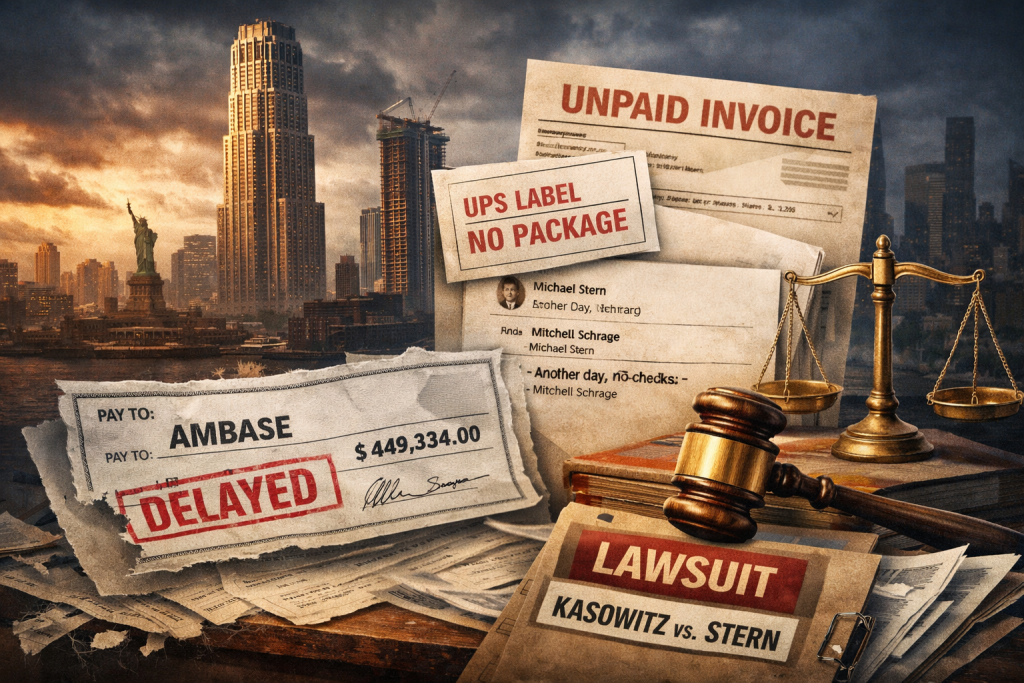
The emails, spanning August 6–11, 2025, show Kasowitz attorneys Mitchell R. Schrage and Alan A. Capilupi pressing Stern on the dispatch of checks related to outstanding invoices.
Key excerpts from Exhibit K:
- “Another day, no checks” — email from Mitchell R. Schrage, August 8, 2025
- Checks sent totaled $449,334 against an expected amount of roughly $1.3 million
- No recorded payments applied since January 24, 2025
All quoted phrasing is taken verbatim from Exhibit K (NYSCEF Doc. No. 22).
“UPS Label Without a Package”: A Detail with Potential Evidentiary Weight
On August 11, 2025, Schrage noted that a UPS shipping label had been created but the package was never handed over to the carrier (“You create a UPS label but don’t give them the package”).
Stern’s reply: “Of course not cmon Mitch… Let me ping Randa.”
In legal and compliance contexts, such incidents are often viewed as indicators of simulated payment activity rather than genuine intent to settle.
Why This Ended Up in Kasowitz’s Lawsuit
As previously reported by JDS Pulse, Kasowitz LLP filed suit against JDS Development Group entities, alleging millions in unpaid legal fees.
Source: JDS Pulse investigation into JDS Development Group: https://jdspulse.com/from-article-to-lawsuit-how-the-jds-pulse-publication-pushed-michael-stern-into-court/
Broader Media Context: A Pattern of Repeated Disputes
Business Insider has repeatedly profiled Michael Stern as a developer entangled in dozens of legal battles. Source: https://www.businessinsider.com
The Real Deal has covered:
- A lawsuit from the Fitzroy condominium (West Chelsea) against JDS entities (October 2025)
- Stern-affiliated entities’ 2025 suit against a “John Doe” over an alleged defamatory website
Source: https://therealdeal.com
Commercial Observer (2022) reported claims over unpaid marketing video content for the 888 Brickell project. Source: https://commercialobserver.com
The Financial Times examined the debt pressures and crisis surrounding Brooklyn Tower (9 DeKalb Avenue). Source: https://www.ft.com
What the Document Proves
Exhibit K does not establish fraud or embezzlement. It does, however, provide documented evidence of:
- Persistent payment delays
- A significant gap between promised and actual remittances
- Eroded trust from a key legal counterparty
Editorial Takeaway
For investors, lenders, and business partners, Exhibit K serves as a cautionary signal: Obligations with this counterparty risk evolving into an endless loop of “we’ll send it soon.”
Court filings like this often carry greater reputational weight than journalistic commentary precisely because they expose raw, documented interactions rather than interpreted narratives.